INVERS Mobility Barometer reports stable European car sharing fleet with 129,000 vehicles in 2026
INVERS’ latest Mobility Barometer finds that Europe’s free-floating and station-based carsharing fleets remain stable at 129,000 vehicles, up 23% from 2023. Covering 42 European countries, the report examines market developments and emerging technology trends.

The latest edition of the Invers Mobility Barometer takes a look at three key car sharing business models: free-floating, station-based and peer-to-peer. Building on the proven structure of previous reports, this edition incorporates current, country-specific research, published data, and insights from interviews with market experts, alongside Invers’ own research. “Over the last 12 months, we’ve seen a dynamic car sharing industry with an overall stable aggregated European fleet size”, says Bharath Devanathan, Chief Business Officer at Invers. “There were mergers, new launches, as well as market exits and the remarkable announcement by the French Transport Minister of increasing the French car sharing fleet to 70,000 vehicles by 2031.”
- Short term fleet size stability: The combined number of European vehicles in free-floating and station-based car sharing remained stable at 129,000 compared to 2025 data.
Station-based and free-floating car sharing account for 129,000 vehicles across Europe. The car sharing fleet size remains at an all-time high with the same size as last year. The two models are roughly equal in size, with an estimated 65,000 free-floating vehicles and 64,000 station-based vehicles. Fleet development varied across markets: many held steady or expanded, while a few contracted.
- Long term growth: The European car sharing fleet today is +23% larger than three years ago.
Car sharing has grown strongly over the past three years. The aggregated station-based and free-floating fleet is 23% larger today than in 2023. In 2023, we estimated an aggregated fleet size of 105,000 car sharing vehicles in Europe. Today, the fleet stands at 129,000 vehicles. Over the past 12 months, select markets sent strong policy signals for the future. France is a notable example, as the French Transport Minister announced a fleet target of 70,000 in France alone by 2031, indicating a chance to continue market growth in the next years.
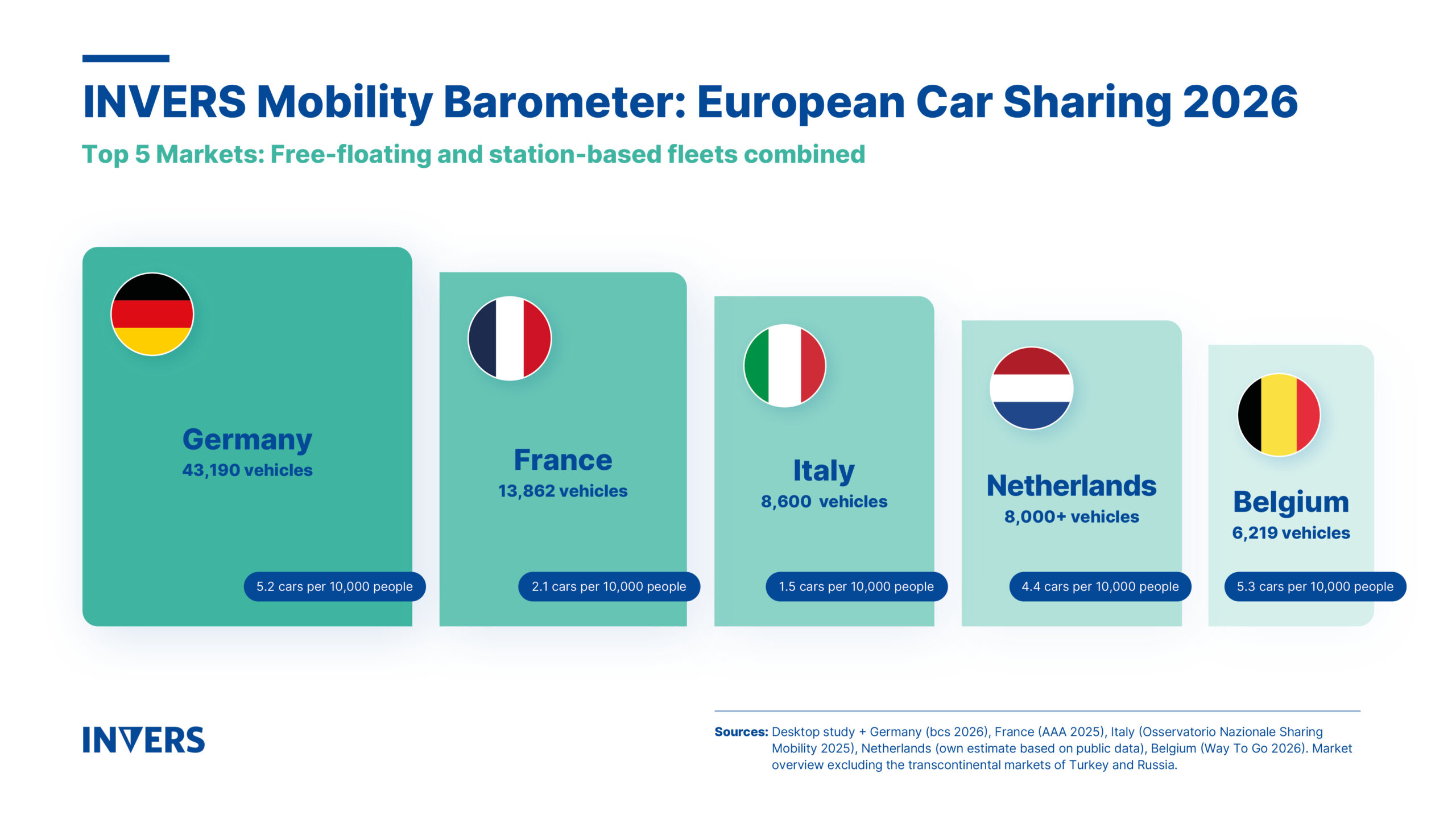
- Top markets: Germany, France, Italy, the Netherlands and Belgium have the largest aggregated station-based and free-floating fleets.
Combining free-floating and station-based car sharing, Germany leads the European market with a total number of 43,190 vehicles. The local free-floating market is dominated by a few operators, while the mature station-based market is extremely complex and heterogeneous. France has a combined station-based and free-floating car sharing fleet of more than 13,860 vehicles, making it the second largest European market, followed by Italy with 8,600 vehicles, the Netherlands with more than 8,000 vehicles, and Belgium with an estimated 6,220 vehicles. Among these top five markets, Belgium and Germany have the highest car sharing density, with more than 5 car sharing vehicles per 10,000 inhabitants. Some smaller countries such as the Baltic states have even higher car sharing densities.
- Diversity: Car sharing operators provide services in 42 European countries.
We identified car sharing operators from station-based, free-floating or peer-to-peer in 42 countries. The majority of operators run station-based car sharing systems, with over 470 such operators identified. Additionally, the report estimates up to 80 operators that run free-floating systems and up to 40 operators that run peer-to-peer systems. European brand diversity has therefore remained at a similar level compared to 2025.
- Emerging trends in AI adoption, an evolving policy landscape, autonomous driving, vehicle-to-grid (V2G), and select mergers and partnerships
Firstly, AI adoption is expanding across use cases. Experts frequently cited AI implementation as a key priority for many operators and suppliers. Secondly, the policy landscape in European car sharing is evolving, proven by various developments in the space, including target announcements, tender processes, and at times, financial support. Autonomous driving is on the roadmap and select car sharing operators are monitoring and testing (partial) autonomous driving capabilities, and planning pilot schemes. Additionally, Vehicle-to-grid (V2G) enters the car sharing conversation. V2G allows idle electric cars in a car sharing fleet to feed power back into the grid during demand peaks, turning parked vehicles into flexible energy storage. Lastly, more operators joined forces or merged as examples like GoMore and Getaround (across Europe), CHECK and Greenwheels (Netherlands), and FLEX and Carloh (Luxembourg) showed.
The Invers Mobility Barometer Vol 6 “European Car Sharing 2026” can be downloaded here.
Latest